|
|
|
|
Last Update 12/12/08
The Seven Beauties of Science Fiction by Istvan Csicsery-Ronay Jr., Wesleyan, 2008, $35, ISBN 978-0-8195-6889-2
The premise of this scholarly work is that “science fiction” has become an attitude rather than just a form of literature. He points out the prevalence of SF themes in movies, recent advances in technology like the internet, and improved critical acceptance of SF (one could argue this point) as signs that the mindset of the world at large has changed. He then breaks down this appeal into seven categories, examining each in detail. Most readers will likely find that the differences among the seven subcategories blurred or even opaque in some cases. Although the book purports to avoid an academic style impervious to uninitiated readers, the prose is very complex and relies heavily on academic jargon. There is some interesting speculation and some of the author’s observations are intriguing, but I doubt this will find much readership among a mass audience, even among hardcore SF fans. 12/12/08
Who Goes There by Nick Griffiths, Penguin, 2008, £7.99, ISBN 978-1-906558-06-2
I enjoyed Nick Griffiths’ earlier book, Dalek I Loved You, a quirky memoir that intertwined the author’s life with his love of the Doctor Who television series. There are bits of autobiography in this one as well, but it’s more an exploration of the British Isles, including visits to various sites where some of the serial were originally filmed. It provides glimpses of the author’s mind and of the character of the contemporary British countryside, as well as a few tidbits about the television show. A selection of photographs would have been nice but the author’s descriptive prose generally makes up for their absence. A mix of travelog, commentary, and memoir, with an unusual pop culture sensitivity. 11/27/08
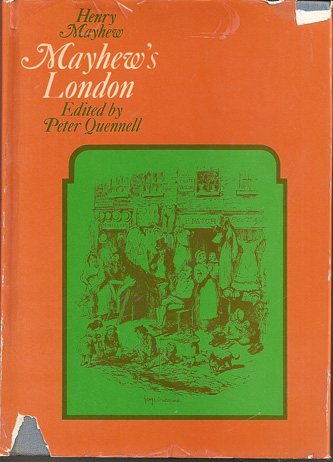
Mayhew’s London, Spring, originally published in 1851
This is a detailed account of life on the underside of London during the Victorian era, a study so exhaustive that Charles Dickens made great use of it for background in his work, and anyone who wants to set a story in this place and time would be well advised to consult it. For the most part, it is a fairly objective study, and in the early sections Mayhew finds much to admire in the lives of costermongers, street salespeople, who carried on a great portion of the commerce at the time. He is, on the other hand, horrified by what they consider entertainment, particularly in cheap music halls where bawdy songs are song, which he considers “poison” that will warp the lives of those who hear the songs forever. Some of his observations I was already familiar with – like the fact that virtually none among the lower classes other than the Irish and the Jewish minorities professed any religion. I was also familiar with the abysmal housing arrangements of that era. I hadn’t realized that the vast majority of “married” couples were actually not, except perhaps under common law. A formal ceremony of even the barest kind was considered an extravagance. Some of the other prejudices of the time are reflected in his observations, although Mayhew is more moderate than some. He refers to the prejudice against the Jewish population as largely self afflicted because of questionable commercial practices, then insists that it is inappropriate to blame all Jews because of the misdeeds of some. But then he mentions that most of their traditional areas and methods of business have been taken over by the Irish and indigenous Britons, apparently ignoring the fact that this means they were guilty of the same or even worse deeds. The accounts of the state of the sewers under London and the art of rat catching and killing were particularly fascinating. Not a book for casual reading, perhaps, but a fascinating resource for writers. 11/15/08
Tour de Lovecraft by Ken Hite, Atomic Overmind, 2008, $14.95, ISBN 978-0-9816792-0-4
I was tempted to call this a novelty book rather than a critical work, but it actually contains some very insightful commentary on the stories and the author is unquestionably very familiar with the body of Lovecraftian criticism. It consists of the author’s reaction to more than fifty short stories by H.P. Lovecraft, treated in chronological order. Some stories are dismissed with only a few sentences, others get a much more extensive treatment. I was particularly impressed with his rebuttal to critics of “The Dunwich Horror” (S.T. Joshi and Don Burleson). The style is very informal and quite accessible to readers who don’t care for deep, analytical treatises, but that doesn’t mean that the commentaries aren’t well thought out and analytical. It’s a nice antidote to those critics who get puffed up with their own self importance and lose track of the fact that they’re supposed to be enlightening rather than obscuring. 11/14/08
Lovecraft Annual Number 2 edited by S.T. Joshi, Hippocampus, 2008, $15, ISBN 978-0-9814888-6-8
Volume two in what presumably is intended to be an ongoing series of collected essays of literary scholarship related to Howard Phillips Lovecraft. This volume includes seven essays plus some reviews and notes by various contributors none of whom, I confess, are familiar to me. Topics include astronomical references in HPL's fiction, paradigm shifts, archaeology, and studies of individual short stories. Of them all, I found, Robert H. Waugh's discussion of "The Rats in the Walls" the most interesting, with Joel Pace and his analysis of "The Thing on the Doorstep" a close second. That said, I must add that there doesn't seem to be much new being said about Lovecraft's fiction, just refined and more detailed re-examinations of aspects already much discussed in the past. Which is not necessarily a bad thing and certainly understandable given Lovecraft's lack of productivity in recent years. A nice sampling of the literature but be warned that there is an academic cast to most of the contents. 10/24/08
The Age of Equipoise by W.L. Burn, Norton, 1964
Continuing my reading about the Victorian era, I tried this one which concentrates on a single generation at the middle of the 19th Century, a period when the rate of change in society was relatively slow. The author opens by presenting a lengthy argument about why the work he is attempting to do is difficult or impossible, including some pointed remarks about an author's inability to escape the preconceptions of his own time. I thought the book generally failed from that point on, not so much because of the author's stated problems, but because he presents a great deal of information in such a disorganized, sometimes almost random fashion that it was impossible to follow some of his arguments and certainly difficult to understand what he was trying to accomplish. Other than a few bits and pieces, I count this one as a waste of time. 10/19/08
Tech-Noir by Paul Meehan, McFarland, 2008, $55, ISBN 9780-7864-3325-4
It felt like a good day to tackle some non-fiction. First up was this "fusion of science fiction and film noir", and since I've been watching quite a bit of the latter in recent weeks, it was a subject that interested me. Some years ago I contributed an article to a collection of essays on the subject, that never got published unfortunately, so I had some preconceived ideas. My definition of noir apparently varies from the author's since I would not have included Soylent Green, although I thought he made a good argument for Metropolis, which I also would have excluded. Some of the films covered in depth are obvious - Blade Runner, the Matrix trilogy, and the vastly underrated Dark City. Some are only touched by the noir influence, if at all, e.g. Attack of the Fifty Foot Woman or The Man With X-Ray Eyes. There's a sort of mini-history of the SF film wrapped up in this specialized, but well written account. As always, I find the McFarland price tags excessive, but the contents are quite good. 10/7/08
The Alchemy of Animation by Don Hahn, Disney, 2008, $19.95, ISBN 978-142310476-6
Animated films are obviously much different now than they were when I was a kid. Computers and sophisticated techniques have altered it almost beyond recognition. The author of this examination of the state of the art, plus some retrospection, knows the field well and presents his material in an organized and informative fashion, illustrated profusely with sketches and stills, most of them in full color. The three techniques covered are computerization, hand drawn, and stop motion photography. Each is discussed in detail including the advantages and disadvantages of all three methods. The author also treats subjects like background settings, story structure, light effects, voice selection, and other elements that the viewer takes for granted. One of the most interesting books about film making I've encountered in some time. 107/08
Star Trek by Ina Rae Hark, Palgrave, 2008, $19.95, ISBN 1-84457-214-5
I confess that I overdosed on books about Star Trek a long time ago. This new one is an academically oriented treatment, apparently part of a series about classic television programs. This relatively brief retrospective discusses some of the most important characteristics of the series, where it followed typical television formats and where it varied. Each of the manifestations of the show are covered, so there's not much depth to the analysis, although what there is was accurate, descriptive, and sometimes even interesting to someone who has probably read twenty previous books on the subject. Those less familiar with the series might want to read this if they're planning to watch the new Trek movie due out next year. It provides plenty of context. 10/7/08
The Vorkosigan Companion edited by Lillian Stewart Carl & John Helfers, Baen, 12/08, $24, ISBN 978-1-4165-5603-9
I find the timing of this book a little strange. Certainly Lois McMaster Bujold's series about Miles Vorkosigan is worthy of commentary and a companion book, but as far as I'm aware she hasn't added to the series in almost ten years. It consists of articles and lists by a number of people including an interview with the author. Some of the pieces are quite useful and interesting - the genealogy, time line, and map for example. Others are just interesting. A few seem unnecessary to me. The concordance might be fun to create, but it's a lot more fun just to read the novels. It's not as though there were dozens of them, and actually they're self contained enough that you could probably read them in any order, although obviously it makes more sense if you do so chronologically. And since the concordance isn't chronological, it wouldn't help. But that's nitpicking. People obviously do like these things because they keep appearing and selling. This isn't a skinny book either, so you'll get more than your money's worth if you're a Bujold fan. 9/27/08
Those Earnest Victorians by Esme Wingfield-Stratford, Apollo, 1930
This study of the Victorian period opens with a frank and sometimes scathing criticism of conditions in England following the Napoleonic Wars, particularly in cities and factories, and suggests that the fact that the nobility lost virtually all of its power, peacefully, within less than two decades following the end of that conflict is one of the most fascinating developments in human history. The author contends that the slow pace of reform in the early years derived from three factors. First was preoccupation with the war against France, and the mindset afterwards to regard opposition as something to be crushed rather than accommodated. Second was the decline in the quality of the nobility, that is, the current generation was more interested in appearance than substance and lacked intellectual rigor. Finally, there were no true leaders among the lower classes and their efforts to secure reform were inconsistent, ill considered, and unproductive. That left only the middle class, which was still emerging as a force in society.
The extent to which the early Victorians elevated appearances above reality is nicely illustrated by reference to a sculptor who created a bust of God for a church, and outfitted him with a wig. The church in England altered its perception of the deity and portrayed the world as being guided by his design, therefore making it unnecessary for humanity to actually attempt to improve its own situation. God became virtually a monster, humanity’s worst enemy, a force to be feared. On the other hand, the atheistic utilitarians thought that every human endeavor could be evaluated mathematically and that the purpose of society should be to increase the amount of happiness through some artificial imposition.
The Reform Act is dismissed as a device by the middle class to more efficiently subjugate the working class, who were actually less well off than they had been after it was passed. The author suggests that this was in part a carryover of the stern God concept, that it was sinful to be poor and therefore those with means should not endeavor to help those less well off, because that would be to encourage sinfulness. He also contends that the most significant event during this period was the growth of the British population beyond the capacity of the land to feed its people. This made the stimulus to advance industrialism and productivity more rapidly than the rest of the world a necessity as well as a virtue.There’s a very convincing refutation of the idea that the Victorian woman was weak, meek, and incapable of managing affairs and a suggestion that their reluctance to leave the household. That’s followed by something of an apology for the perception of snobbery and shortsightedness, and a general summing up. The book is presented in a very personal, non-academic style and the prose is outstanding. 9/27/08
Bram Stoker's Notes for Dracula annotated by Robert Eighteen-Bisang and Elizabeth Miller, McFarland, 2008, $65, ISBN 978-0-7864-3410-7
This is exactly what the title would lead you to expect, a facsimile edition of the hand written notes Bram Stoker used in the creation of his most famous novel, Dracula. In most cases the handwriting is pretty clear, but the annotaters have provided a transcript of all the documents, with extensive notes explaining the background, hidden meanings, and other aspects of each of the notes. There are also essays describing the work in general, and specific elements of the story and narrative techniques, the relationship to the historical Vlad Tepes, a short biography of Stoker, bibliographical material, a list of Stoker's private books, and other short pieces. A very interesting compilation for scholars and devoted fans of the original book. A very interesting look into the creative process. 9/11/08
Walt Disney's Imagineering Legends by Jeff Kurtti, Disney, 2008, $35, ISBN 978-078685550-9
I picked this up thinking it was a history of how Disneyland was conceived and constructed. Well, in a way that's what it's about, but not in the manner I had expected. The book deals primarily with the creative team whom Disney employed, and is more about how they worked together, or sometimes didn't work together, to craft a common vision. Necessarily there's a lot of detail about the actual planning and construction, but that's almost peripheral to the real issue, which is how such a large and disparate group could be shaped into a cohesive force. There are lots of illustrations, photographs and drawings, personal profiles and anecdotes. I'd still like to find a more comprehensive book about the actual building of the park, but this was fascinating in its own way. 8/27/08
Mystic Dreamer Tarot by Heidi Dorros and Barbara Moore, Llewellyn, 2008, $26.95, ISBN 978-0-7387-1436-3
In this box set we have a set of 78 Tarot cards, each with a new painting of all the classic figures - Death, the Hierophant, Swords, Cups, Pentacles, etc. There is also a cloth bag to hold the cards and a lengthy paperback by Barbara Moore which provides an introduction to Tarot reading, with a brief description and interpretation of each of the cards. There are also instructions for laying out the cards, doing readings, and so forth. I would have preferred a nice history of the Tarot but that's another book. The artwork is nice and the book is aimed at beginners, so it's straightforward and probably oversimplified. It would make a nice novelty gift but I imagine devoted Tarot fans might find the book beneath their notice. 8/27/08
Crime and Society in England 1750-1900 by Clive Emsley, Longman, 1987
I had to read this one in little bits and pieces because (1) it's full of information, and (2) most of the information is pretty boring. It was part of my effort to improve my knowledge of the details of the Victorian era, but unfortunately it was long on statistics and comparatively short on interpretation and context. Some of the analysis is interesting, particularly the author's discussion of politically or socially motivated crimes - like shoplifting by a starving person - and his conclusion that the changes in the law were not the result of efforts by foresigned humanitarian activists. Not for the casual reader. 8/25/08
Zombie CSU by Jonathan Maberry, Citadel, 8/08, $16.95, ISBN 978-0-8065-2877-9
This one is subtitled “the forensics of the living dead” and, as you might guess, is a sort of guide to and history of zombies in movies and books. With lots of amusing illustrations, the author examines the kinds of zombies, the actual legends from Haiti, the George Romero effect, and various ways of battling them if you should find yourself being pursued by a horde of shambling animated corpses or their equivalent. The book doesn’t take itself too seriously, obviously, and has lots of sidebars and quotes and other goodies. You probably don’t even need to read it in any particular order. The artwork comes from too many artists to mention here but most of it is interesting if not always aesthetically pleasing, given the subject matter. 8/11/08
Flight Volume Five edited by Kazu Kibuishi, Villard, 2008, $25, ISBN 978-0-345-50589-7
The fifth volume in this apparently ongoing series of collections of illustrated, full color graphic stories has examples of work by more than twenty artists and writers, but I'm afraid I'm not well enough attuned to the market to tell you who the movers and shakers are. I was particularly impressed by the pieces by Kness & Made and by Matthew Bernier, although some of the other stories are as good or better. This is a nice big thick volume, more than 300 pages, and the quality - though varied in style and theme - appears to be extremely high throughout. I suspect that this series would provide a quick and very effective overview of the graphic story scene to those like me whose interests lie primarily elsewhere. 8/6/08
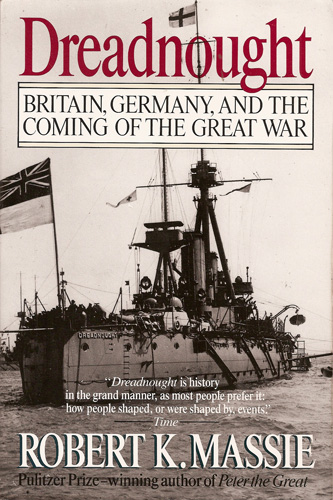
Dreadnought by Robert K. Massie, Ballantine, 1991
I’ve been trying to read one chapter a day of this history of Europe between about 1890 and 1914 for several weeks – the book is over 900 pages long. Massie examines history largely through the people who made it, primarily in this case in the British and German governments, including Winston Churchill, David Lloyd George, the Prince of Wales, Kaiser Wilhelm, Otto Von Bismarck, Admiral Tirpitz, and many others. High points for me were the sections on the Moroccan Crisis, the British version of Douglas MacArthur’s insubordination – Admiral Beresford, and a few other diversions. I was surprised to discover how close England and Germany came to being allies, and how the Germans foolishly threw the chance away, as well as how much World War I amounted to a family squabble and the petulant activities of a not particularly sane German Emperor. I have read a great many books about European history over the years, but I don’t think I’ve ever read one that impressed me as much as this one did. The only area not covered in depth is the Balkan Wars, so I guess I need to look for another book. 7/24/08
The Mad Scientist Hall of Fame by Daniel H. Wilson and Anna C. Long, Citadel, 8/08, $14.95, ISBN 978-0-8065-2879-3
Here’s an odd kind of book you won’t see every day. The authors have created profiles of some “mad scientists” drawn from books, movies, comic books, and even real life, arranging them in sections. First we have those bent on world domination like Dr. No from the James Bond novel, then intrepid if rather obsessed explorers like Captain Nemo from Jules Verne, then a pair who communicated with aliens, the real life Nicholas Tesla and Lex Luthor from the Superman comics. Next come those who experimented with humans, like Mary Shelley’s Dr. Frankenstein and H.G.Wells’ Dr. Moreau. The last two sections include those who died in the name of science – Dr. Jekyll and Madame Curie, among others – and a few who were just angry, rather than mad, like Oliver Heaviside. Each profile includes a psychological analysis. A few of the entries were people I wasn’t familiar with. Amusing. 7/7/08
The Pyramids of Egypt by I.E.S. Edwards, 1947
This is another of those books that wasn’t quite what I expected and I skimmed over large portions of it. The sections which deal with the history and religious system of ancient Egypt are very interesting and well written. Unfortunately, a very large proportion of the book involves the precise measurements of the passageways, rooms, and other dimensions of the various pyramids. I was surprised at the diversity in the kinds of pyramids which were built but the discussions of floorplans, despite diagrams, frequently lost my attention. I would also be curious to discover how much of the information which the author says is as yet unknown has been uncovered in the sixty years since this first appeared, and how many of the assumptions in the book are no longer accepted. Obviously I need to find more on the subject. 6/20/08
Life Under the Pharoahs by Leonard Cottrell, 1955
I realized that I knew very little about ancient Egypt other than mummies and Cleopatra, so I've picked up a couple of books to fill in some background. This one looked promising but wasn't what I expected. It attempts to describe everyday life in ancient Egypt, but does so by alternating fairly informative chapters with semi-fictional accounts that don't work as fiction and are too light weight for non-fiction. The other chapters are much better and gave me a general idea of the elaborate system of gods, the basics of their economy and government, and a faint idea of their history from 3000 B.C. forward, but it was more tantalizing than satisfying and I'll be delving into other sources in due course. 6/17/08
Urban Crime in Victorian England by J.J. Tobias, Schocken, 1967
The author of this scholarly analysis spends the first several pages explaining why the statistics from 19th Century England on crime (and other matters) are so unreliable. Not only were their different methods of recording and reporting crime, but even the definitions were not consistent, and some towns had no police force at all. What we call white collar crime wasn’t considered criminal at the time, and the privileged class was allowed to do things that would get anyone else arrested. Similarly, people arrested lied about their age and background, frequently in order to ensure that they were sent to a particular prison or enrolled in a particular program. Despite all these caveats, the author suggests that it is still enlightening to look at these same statistics. Much of what follows is rather dry, but there were bits and pieces that were very interesting, particularly the section involving societal structures created within the criminal element. Not very entertainingly written, however. 6/16/08
H. Beam Piper: A Biography by John F. Carr, McFarland, 2008, $39.95, ISBN 978-0-7864-3375-9
H. Beam Piper's reputation is based primarily on two separate series, one about the Fuzzies, cute little creatures whose legal status as an intelligent species is the subject of three novels, and the alternate history adventures of Lord Kalvan. Despite a relatively small body of work, he remains one of the more familiar names in the field, at least to seasoned SF readers. John F. Carr, who has been involved with popularizing Piper's work in the past, has now written a biography of the man, whose private life was something of a mystery, although it was well known that he collected guns and was a heavy drinker. Piper ironically committed suicide, heavily in debt and convinced his career was going nowhere, just before his popularity began to rise. Carr's biography portrays Piper as outspoken, intense, and intelligent. He married late and never seemed quite at ease in that role. Carr includes family photographs and excerpts from Piper's correspondence to flesh in details about a man who never lived to discover how influential his work would eventually be. 6/5/08
Out of Picture 2, Villard, 2008, $26, ISBN 978-0-345-49873-1
I almost always feel inadequate reviewing art books, and although this is a collection of short graphic stories, they are almost all very short on text and very heavy on art, full color and tinted, in a variety of styles. The contributors include more than a dozen graphic artists, none of whom are familiar names to me. The stories range from the fantastic to the mundane, from serious to humorous, from realistic to surrealism. Most of the art seems relatively minimalist, with little detail, a form I don't always enjoy, although in about half of these that style seemed a good fit. You're more likely to enjoy this by paging through and enjoying the art than in relishing the stories, which are often secondary considerations. 6/3/08
The Irresistible Theater by M. Bridges-Adams, World, 1957
This comprehensive history of the English theater starts by examining the evolution of acting in general, the early conflict with the Christian church, which eventually co-opted the art as pageants and religious festivals, only to lose control when audiences demanded novelty. One of his interesting speculations is that most of this was just impersonation and recitation until the advent of the printing press. When it became possible for people to acquire printed copies of the words of songs and stories, the mimes and even minstrels were forced to find some new way to interest people in their efforts, so they began to act out part of whatever work they were performing. He then examines the precursors of Shakespeare, including Christopher Marlowe, and briefly discusses and dismisses the view that Shakespeare did not write the plays attributed to him, citing as evidence the author’s admitted pilferage of ideas from earlier plays. He poses an interesting theory at this point, suggesting that the absence of copyright protection at the time was actually conducive to the creation of great art. If Shakespeare had faced the laws and restrictions that surround writers today, he would have spent more time in court than anywhere else. Much of the book consists of brief biographies of various minor playwrights and I skipped over some of it. Parts of this are for very specialized tastes, obviously, but other parts provide an interesting glimpse of an aspect of English history not usually given much attention. 5/29/08
Gilbert: His Life and Strife by Hesketh Pearson, Harper, 1957
This somewhat truncated biography of W.S. Gilbert concentrates mostly on the more controversial aspects of his life, his prickly personality as well as his great talent. As such, it skips over his childhood and only briefly mentions his marriage, concentrating instead on his dealings with other writers, actors, and theater managers. Gilbert comes across as an honest, often generous, but even more often contentious man acutely aware of his prerequisites and with a perhaps overly developed desire that the proper rules be followed. He was constantly threatening or pursuing lawsuits, sometimes on trivial matters, and once crossed he was disinclined to ever forgive. He was also a perfectionist who believed himself always correct. The author also contends that Gilbert didn’t actually enjoy writing and considered it a craft rather than an art, something he did to earn money that was of little interest to him in itself. Despite his prickly nature, Gilbert was largely responsible for the introduction of discipline into the acting profession. The author also asserts that the differences between Gilbert and Sir Arthur Sullivan, which were many, actually helped make their partnership more fruitful, although there were frequent quarrels and periods of alienation. The overall impression I got from the book was that Gilbert was a rather peculiar, talented, but narrowly focused man who spoke before thinking and rarely intended to be as offensive as he almost always was. 5/14/08
Rhetorics of Fantasy by Farah Mendlesohn, Wesleyan, 2008, $27.95, ISBN 0-8195-6868-6
Another serious look at fantasy, this one by someone who is actually familiar with the field. For the author's purposes, fantasy means any non-realistic fiction, as she refers to both traditional fantasy and horror and even a few science fiction titles. The thrust of the book is to suggest that all such work falls roughly into four categories, each defined by how the protagonists relate to the non-realistic events in their world. The author is careful to state that this is not meant to be a rigid system and provides a different way to think about fantasy rather than an attempt to strictly define it or set up a system of rules about how it works. The authors she considers are varied, from Robert Jordan to Jeffrey Ford to Brian Stableford, and she also discusses several older classics of the genre. I was a bit surprised not to see Ursula K. Le Guin and a couple of other omissions, but the book is obviously not meant to be comprehensive and their absence doesn't have any impact on her premise. Although the language is largely that of the academic community, the author's system of examining fantasy offers some interesting perspectives to general readers as well. 5/7/08
Feminist Narrative and the Supernatural by Katherine J. Weese, McFarland, 2008, $35, ISBN 978-0-7864-3615-6
My appreciation of this examination of fantastic elements and feminism by the authors of seven recent novels by women was somewhat dimmed by the fact that I'd only read two of the novels. Weese examines work by Margaret Atwood, Toni Morrison, Carol Shield, Marilynne Robinson, and Barbara Kinsolving, none of them even close to the mainstream of contemporary fantasy fiction. Given my unfamiliarity with the work, I can't comment on the accuracy of her analysis, although it seems quite cogent and insightful. The Atwood and Morrison essays were the most accessible to me because I'd read the work they were based on. Although Weese takes an academic stance, her prose only occasionally hints at academese, and I had no trouble following her arguments. This one probably won't have much feel to mainstream fantasy fans but should be of interest to those interested in feminist theory or the authors she examines. 5/4/08
Dreams and Nightmares by Mordecai Roshwald, McFarland, 2008, $35, ISBN 978-0-7864-3694-1
It has been many years since I read Roshwald's novel of atomic armageddon, Level 7, but I still remember it, and I was pleasantly surprised to see his name appear on this new book, which examines "science and technology in myth and fiction." It's a scholarly work that looks at how artists have incorporated scientific advances into their creations, and most of the contexts examined are not traditional SF. They include the Bible, Greek mythology, and other ancient sources as well as more recent fiction by Wells, Orwell, Robert Louis Stevenson, and others. Despite the scholarly approach, the book is quite accessible for the average reader, providing considerable insight in some cases and illuminating some of the work by pointing out complexities that might otherwise have gone unnoticed. Included is an analysis of Roshwald's own fiction, an unusual device that caught me by surprise. Like most books from this publisher, I think the price is rather steep, but I did enjoy reading it. 5/3/08
Physics of the Impossible by Michio Kaku, Doubleday, 2008, $26.95, ISBN 978-0-385-52069-0
There have been several books published examining the science in one or another SF television show or movie, but none can approach the effectiveness of this comprehensive look at the possibilities of technology. The author, a prominent physicist, divides the various elements of SF – force fields, telepathy, time travel, faster than light travel, etc. – into three categories – theoretically possible, not theoretically impossible but unlikely for millennia, and contradictory to our understanding of the laws of physics. He then examines each individual element, explaining its basis in scientific history, and various ways in which it could be achieved. The text is intelligent without being opaque to those of us lacking a rigorous scientific background, and entertaining enough to keep me reading right through to the end. Easily the best book on the subject I've ever encountered. 4/30/08Charles Fort: The Man Who Invented the Supernatural by Jim Steinmeyer, Tarcher, 2008, $24.95, ISBN 978-1-58542-640-9
The Book of the Damned by Charles Fort, Tarcher, 2008, $18.95, ISBN 978-1-58542-641-6
The biography of Charles Fort arrived at just the right time for me as I was feeling the need to read some non-fiction. I didn’t care for the subtitle, since he neither invented it nor believed in it. Fort was a skeptic and a satirist who believed that science was only one way of looking at phenomena and that scientists were as narrow minded as were superstitious people. He collected copious information about unexplained events and wove them into four volumes which, while fascinating reading at times, are arranged in a very convoluted and difficult style. The publisher has combined all four into the companion volume listed above – unfortunately confusing things by using the name of one as the collective name for all – but New Lands, Lo!, and Wild Talents are all included as well.
Fort was undoubtedly influential, as the biography contends, but compromises his position by including poorly documented data that is often just word of mouth exaggerations. The biography did tell me a lot about Fort that I hadn’t known, his ambitions to sell fiction and the very dismal results of his efforts, his close friendship with Theodore Dreiser, who tried to promote his friend’s career, his distrust of the medical profession. I have a much better sense now of the man and the reasoning behind his choice of what to include and what to exclude, and as writers go he led a surprisingly interesting life. The text draws heavily on Fort’s own correspondence and notes. It was also interesting discovering some of those who reacted negatively to Fort’s work – including notably H.G. Wells. 4/16/08
Dalek I Loved You by Nick Griffiths, Gollancz, 2008, £7.99, ISBN 978-0-575-08219-9
This personal memoir is by a man whose life was tied up with Doctor Who, thankfully not to the point of obsession. The book is a very informal recounting of the author's life, jumping around in time a great deal, which also seemed to impinge upon one or another incarnation of the Doctor. He's not an indiscriminating fan - he cites a number of bungles and bad ideas - but he forgives the errors because of the overall spirit of the show, the sense of wonder, and perhaps the mere fact that it remained so consistently popular, even during the long period when no new episodes were being filmed. This isn't a history of the show and there are no revelations or insightful interpretations, but it does provide a glimpse into the reasons why we Whovians remain so loyal. And it doesn't hurt any that Griffiths is a very amusing writer. 4/14/08
Secrets of the Wee Free Men and Discworld by Carrie Pyykkonen and Linda Washington, St Martins, 2008, $9.95, ISBN 978-0-312-37243-9
The Wee Free Men, a young adult Discworld novel, is set to be the next of Terry Pratchett’s works to come to the screen, so tie-in books are inevitable. This is an unauthorized exploration of the “myths and legends of Terry Pratchett’s multiverse” which looks at many of the character types, objects, and magic of that universe. This appears to be aimed at younger readers. Some of the entries are designed to be humorous in themselves, others are just descriptive. The first section of the book – which examines Pratchett’s fiction as having developed from other literary forms – is pretty good. The second and longer portion, is more uneven, mostly a who’s who to the characters and races. Those who have already ready the books will know all this, and those who haven’t probably won’t be interested enough to read an entire book just to find out. 3/28/08
Superheroes! by Roz Kaveney, I.B. Tauris, 2008, $18.95, ISBN 978-1=84511-569-2
Comics authority Roz Kaveney takes an in depth look at superheroes supposedly in comics and film although most of the text is certainly on the former. Since my familiarity with comics is primarily Marvel and to a lesser extent DC, I wasn't familiar with a lot of the subject matter, which was both an advantage and a disadvantage, the former because the information was generally new to me and often very interesting, the latter because I missed a great deal of the context and sometimes had trouble following what was being said. This is not, however, the author's fault because the prose is concise, well organized, and intelligently written. I was particularly interested in the comments on Joss Whedon, since I was a fan of both Buffy and Firefly, and some of the other comments on films, all of which I'd seen and few of which I considered equal to the original material in freshness, although they were generally much better in execution. Her comments on the way characters are rebooted - reinvented when those responsible want to pursue a different tone or story line - were also quite interesting. Alias and the Watchmen both get more extensive, in depth treatment. An excellent book for both those who know the material and those who are less familiar with it and wonder about the fascination with comic book heroes. 3/20/08
Captain Kirk's Guide to Women by John "Bones" Rodriguez, Pocket, 2008, $14, ISBN 978-1-4165-4315-2
It appears that the publisher is having trouble finding new Star Trek tie-in books of late; if this is any indication of the future, they can stop any time. It consists of brief summaries of Kirk's relationship with the various women he encounters, including quotes, dating habits, plot summaries as they relate to the issue at hand, and Kirk's strategy for dealing with the individual. There are some full color photographs scattered through the book, but oddly enough very few of them are of the women. I'm sure it will find its audience somewhere, but I'd rank this concept as even lower than the nth Star Trek trivia book. 1/31/08
The Influence of the Imagination edited by Lee Easton and Randy Schroeder, McFarland, 2008, $35, ISBN 9780-7864-3230-1
This is another collection of academic essays, the theme this time being science fiction and fantasy as "agents of social change". In other words, can reading a piece of speculative literature alter an individual's view of the world, and by extension that of enough people to actually bring about social change? The simple answer is no, as far as individual works are concerned, although I imagine that the genres as a whole may have some effect. I think it more likely that they reflect changes already in process though. Russia didn't throw out the communists because they read George Orwell. Anyway, these essays are on the usual subjects - Le Guin, the role of gender in society, mass media, dystopia, cultural imperialism, and so forth. Marie Jakober was the only author I'd ever heard of previously. Some are written in partly impenetrable academese although most are accessible enough. Quite a few deal with what fans would consider peripheral or less than central works, but that's also par for the course. A healthy price tag on this but it's better than most similar books. 1/22/08
Future Noir by Paul Sammon, Gollancz, 2008, £16.99, ISBN 978-0-575-08160-4
I read the earlier version of this book back about ten years ago when it first appeared. It's the story of the making of the movie Bladerunner, based on Philip K. Dick's Do Androids Dream of Electric Sheep? Although I've always enjoyed the movie, it has never been one of my real favorites but paradoxically this is one of the most enjoyable "making of" books I've read, partly because Sammon writes well, partly because the process in this case is interesting in itself. I only skimmed the familiar stuff this time, but looked more closely at the new additions that I could identify, of which there is quite a bit, including scores of photographs, most of which I thought could easily have been left out, and interviews with Harrison Ford and Ridley Scott, the former of which I found particularly interesting. The section on differing versions is potentially very useful, since there have been so many. Although most of this is specific to this film, a good deal is applicable in general, so you get an interesting insider look at the industry as well as the movie. 1/20/08
The Fan's Guide to the Spiderwick Chronicles by Lois Gresh, St Martins, 2008, $9.95, ISBN 978-0-312-35153-3
This is the unauthorized companion book to the Spiderwick Chronicles, a series of five adventures for younger readers by Holly Black and Tony DiTerlizzi (who are, I believe, doing a follow up series). The series - which is coming to the screen this year - is amusing fare for younger readers, though nothing out of the ordinary. Gresh, who has done similar books, takes a very casual approach to the subject, and some of her text is amusing in itself. There's not a great deal of substance, just some general talk about aspects of the characters and magical beings, quizzes, some very brief, somewhat associated stories, a way to decide what magical being you might be, and a glossary that I thought was the best part of the book. If your kids read the books, this should please them. 1/1/08